No Result
View All Result
Saturday, December 13, 2025
23 °c
Tripoli
24 ° Sat
24 ° Sun
  • Advertising
  • Contact
LibyaHerald
  • Home
  • Libya
  • Business
  • Opinion
  • Magazine
  • Advertising
  • Login
  • Register
SUBSCRIBE
  • Home
  • Libya
  • Business
  • Opinion
  • Magazine
  • Advertising
  • Login
  • Register
No Result
View All Result
LibyaHerald
No Result
View All Result
Home Libya

Inside Tripoli Zoo’s prison for illegal immigrants

bythomwestcott
August 26, 2013
Reading Time: 4 mins read
A A
Inside Tripoli Zoo’s prison for illegal immigrants

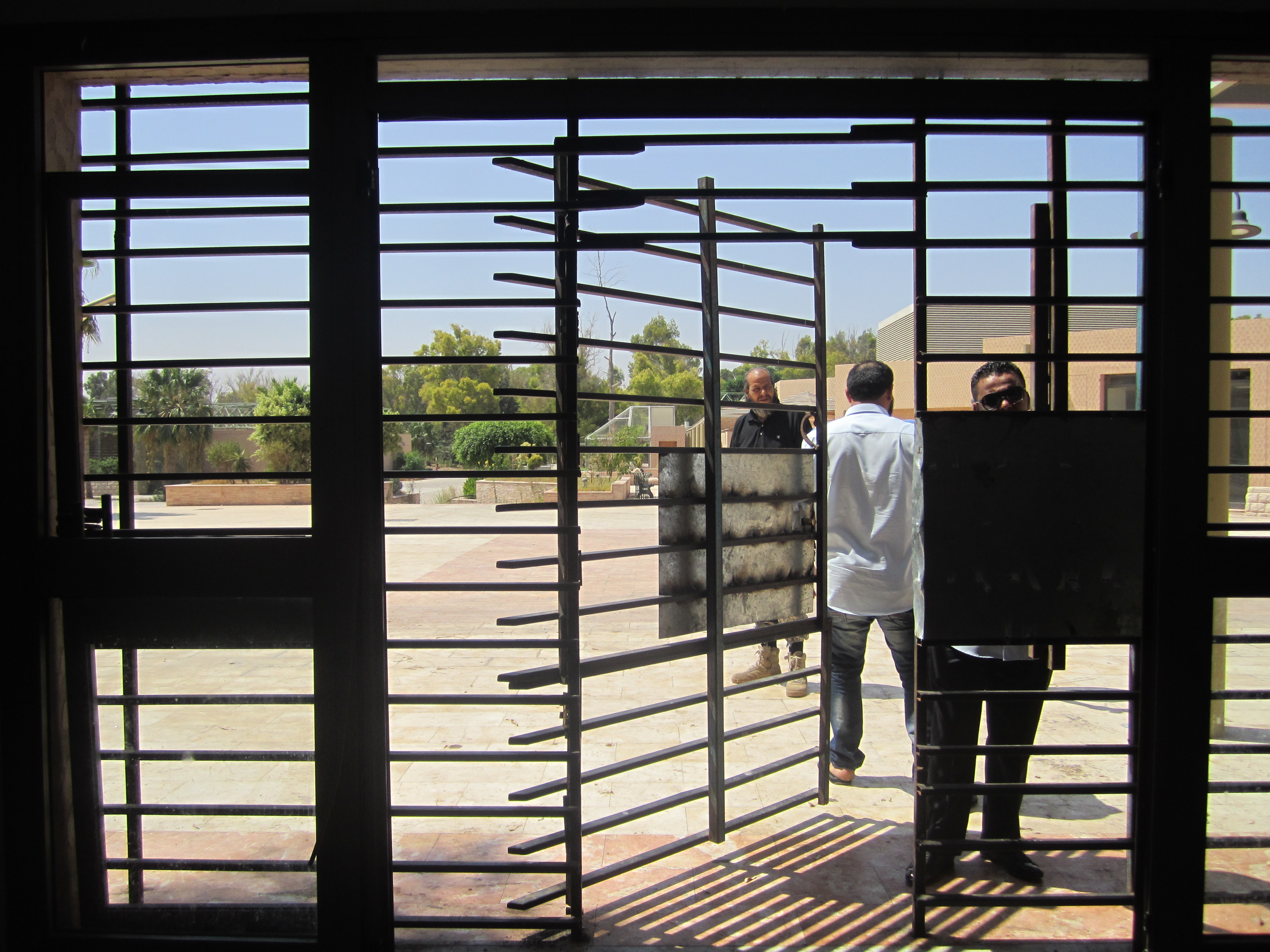
The detention cell looks out into the grounds of tripoli Zoo (Photo: Tom Westcott)

By  Tom Westcott and Ashraf Abdul Wahab.
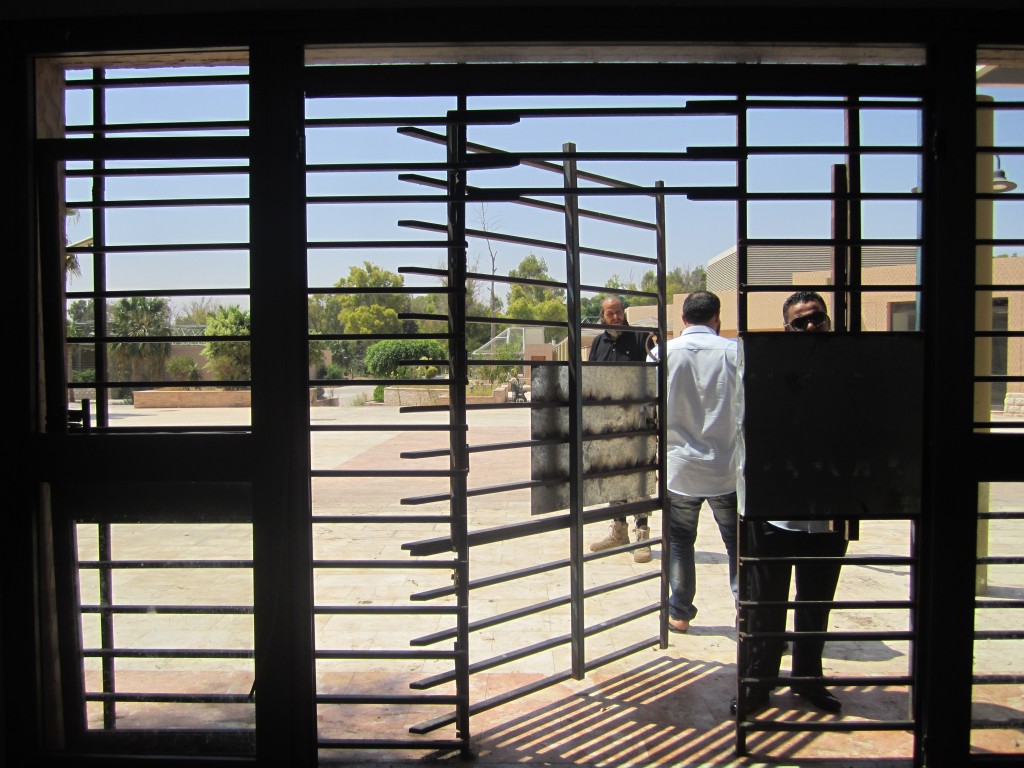
The detention cell looks out into the grounds of Tripoli Zoo, where detainees held for more than a day may do some maintenance work (Photo: Tom Westcott, Libya Herald)

Tripoli, 26 August 2013:

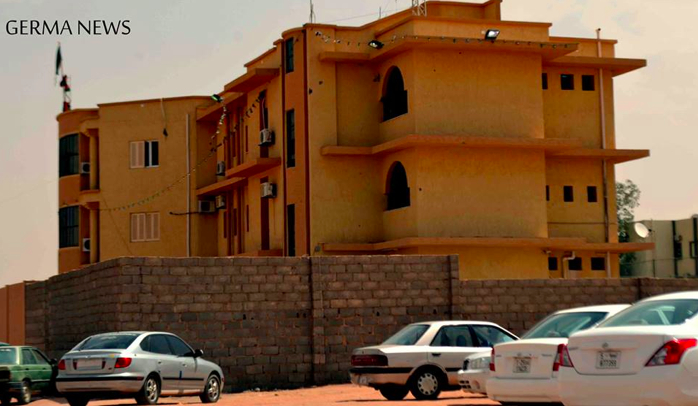
Tripoli zoo is being used to hold foreigners found working illegally and . . .[restrict]picked up by a unit of the capital’s illegal immigration department.

The zoo, closed to the public although still home to several hundred animals, now also houses the operations room of a group of 43 brigades working under Commander Said Gars Alaha. One of these brigades is tasked with checking the health and paperwork of immigrant workers, establishing who has the right to work in the country.

Libya has a poor reputation for detention conditions for refugees and migrants, described as “deplorable” in a recent Amnesty International report. However, both Alaha and the head of the illegal immigration unit based at the zoo, Abdul Razag Al-Gerjame, are keen to point out that they respect the human rights of those they arrest.

RELATED POSTS

Top law firm joins new British Libyan Business Association

An academy with a difference in Tripoli

“I’m feeding these people with the same food as I and my soldiers eat,” Alaha said. The food – baguette-style sandwiches – is, he said, paid for by members of the underfunded brigade themselves.

The prison itself, on the edge of the grounds of the zoo, has heavily-barred doors and windows. Inside, however, it is surprisingly light, with two air-conditioned rooms, a sink and toilet, and supplies of bottled drinking water. An ironic sticker, grazed by a gunshot hole, on one of the doors advertises a Libyan tourism company.
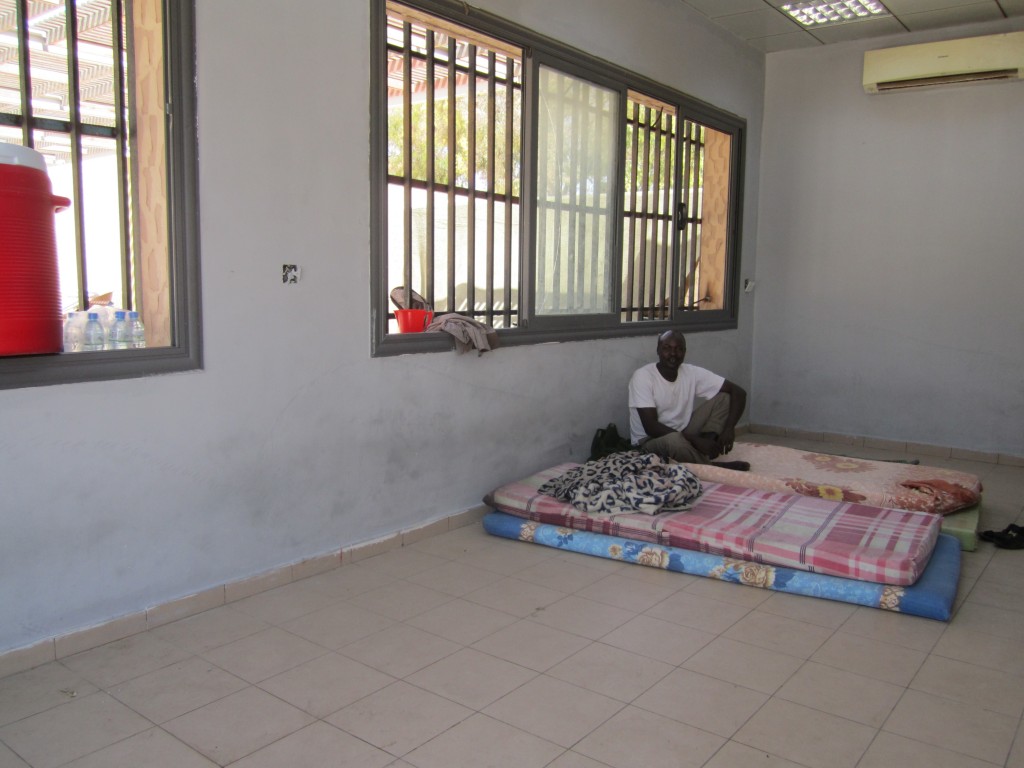
A detainee sits in the main room of the prison, waiting for the results of a blood test (Photo: Tom Westcott, Libya Herald)

When Libya Herald reporters visited the prison, the main room had four mattresses but only one occupant. Two other prisoners were out doing maintenance work in the zoo. The building was chosen to be the prison cell, Alaha said, because it was one only a few available that had air-conditioning.

The rooms, however, were not particularly clean and there was a trail of drops of blood on the floor between the two back rooms. One of the guards explained that this was from a Libyan who had spent the previous night incarcerated, after being arrested for causing trouble outside the zoo. He was crazy, the guard said, smashed one of the windows and cut himself with the glass.

The institution acts as a holding centre rather than a prison. “We don’t keep anyone here for more than 72 hours,” Alaha said, explaining that most inmates leave within 24 hours, either released – if their paperwork and health are in good order – or transferred to local detention centres for illegal immigrants.

The unit makes arrests made on a daily basis, setting up checkpoints across the city where workers are stopped and have their paperwork inspected. In the last four months alone, Al-Gerjame said, they have arrested 5,000 people, most of whom are from neighbouring African countries.

Libya Herald reporters witnessed a group of ten arrested workers being brought into the zoo. They were questioned about their country of origin – they were from sub-Saharan Africa, Tunisia and Morocco – and their paperwork, if they had any, was inspected. No guns were in evidence and the detainees were treated respectfully.
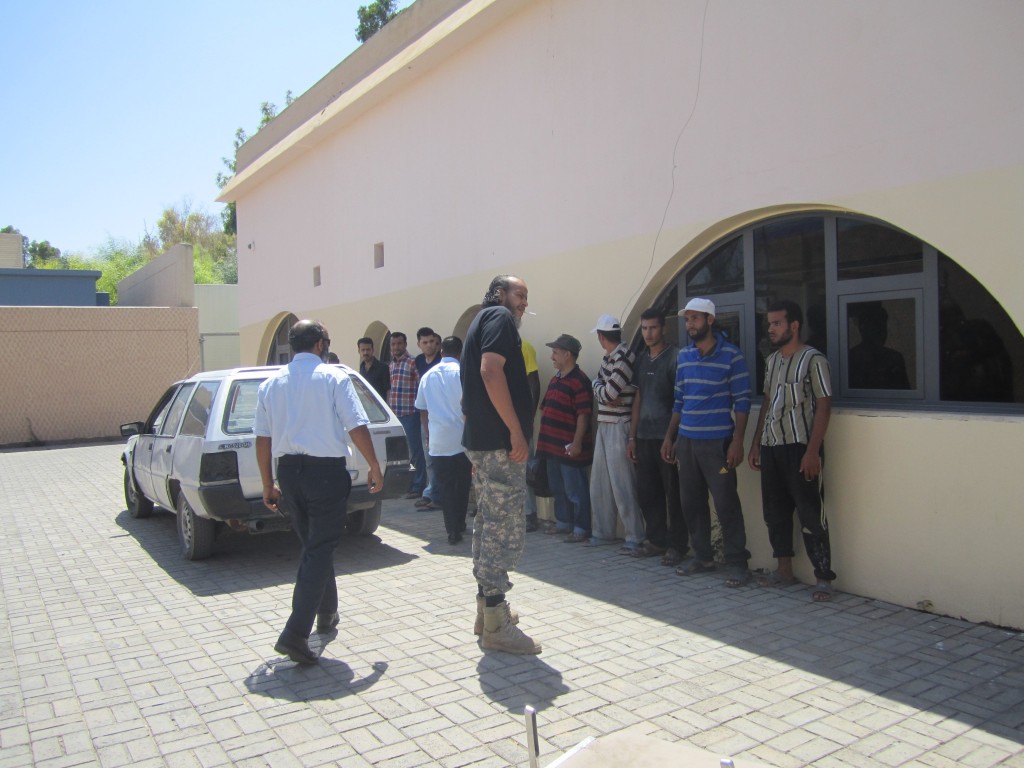
Newly arrested immigrants are questioned before having their health checked with blood tests (Photo: Tom Westcott, Libya Herald)

One man from Sudan said he had been working in the country for a year and was planning to leave Libya in a week. “It’s always the same story,” Al-Gerjame said, shaking his head: “Everyone says they are leaving in a week.” He said others with photocopied visas or fake health certificates may have been conned into believing the documents were genuine.

The immigrant workers are allowed to keep their phones with them so they can ask friends or relatives to bring their passports and paperwork to the zoo. “By this evening, probably half of these people will be released,” said Al-Gerjame.

They also undergo blood tests, the results of which are analysed at a government medical centre. Serious diseases of the blood are prevalent amongst migrant workers, Al-Gerjame said, estimating that 20 percent of those arrested test positive for Hepatitis or HIV.

Many of these people have health certificates issued by the Ministry of Health. These can be purchased on the black market for just LD 50 – an option taken by those who think or knows they are HIV-positive. “When they test positive and I ask them why they have a clean medical health card,” Al-Gerjame explained, “they say: ‘I pay the LD 50 because I want to work.’”

There are special detention centres for those with diseases while they await deportation. “If they are ill, they will be transferred outside Libya,” Alaha told the Libya Herald: “If there is no illness, and they have visas, they can stay here and work and pay taxes.”

Political refugees working illegally are also an increasing problem for Libya. “More than 10,000 Syrians have come here since their revolution started,” Al-Gerjame said, “they say they have come through the Emsaid border crossing between Egypt and Libya, but they have no stamps in their passports.”

The border crossing does have an illegal immigration department but, Al-Gerjame said, it is unable to cope with the numbers of people trying to enter the country. He added that whilst these refugees and migrants used to stay in the east of the country, they were now heading to Tripoli, looking for more opportunities to work illegally.

“We cannot return these people to their countries because they have refugee status,” Al-Gerjame said, “so we have to keep them here in Libya.” Workers from Eritrea, Ethiopia and Somalia also cannot be sent home. “This is Libya’s biggest problem,” Al-Gerjame said, “and we have asked the United Nations for help but nobody has any answers.”
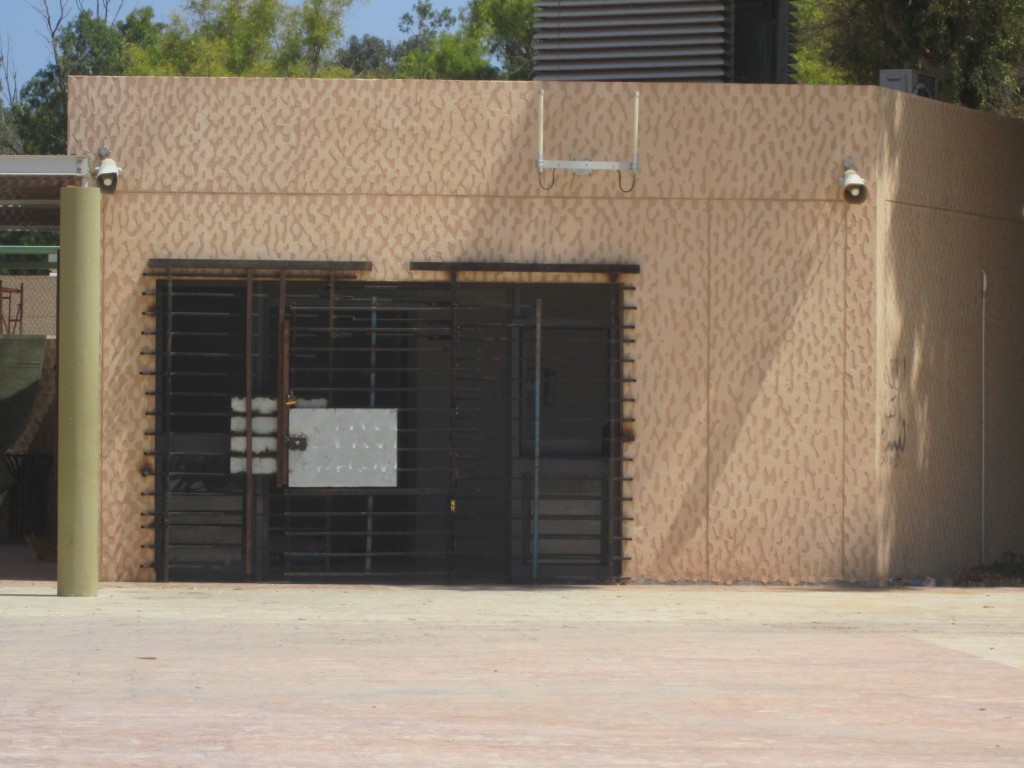
The prison holds people for up to 72 hours, although most are released or taken to illegal immigration detention centres within 24 hours (Photo: Tom Westcott, Libya Herald)
[/restrict]

Tags: detention centrefeaturedillegal workersLibyaTripoli zoo

Related Posts

ACA reveals 94,000 cases of state sector salary duplication in 2015
Libya

“Building Libyan National Capacities in the Fields of Combating Corruption and Money Laundering 2025–2027” agreement signed between ACA and UNSMIL at Anti-Corruption event

December 10, 2025
CBL Governor Issa announces three strategic initiatives to build a stronger banking sector at 6th Banking Sector Development Forum in Tunis 7 to 9 December
Business

CBL Governor Issa announces three strategic initiatives to build a stronger banking sector at 6th Banking Sector Development Forum in Tunis 7 to 9 December

December 7, 2025
CBL receives results from meetings with international banks
Business

Latest CBL stats to November 2025 show significant growth in Libya’s electronic banking sector

December 6, 2025
Nine deaths and 16 injured in Tajura state-recognised militia clashes
Libya

Overnight Zawia clashes end with civilian injuries and unconfirmed deaths

December 5, 2025
Interior Ministry’s Diplomatic Missions Protection personnel receiving training in Ukraine
Libya

Three million illegal immigrants in Libya, 75 % of whom are families, constitute ”settlement” which Libyans reject – illegally transfer US$ 7 billion annually: Interior Minister Trabelsi

December 4, 2025
EU to end Operation Sophia and to launch new Mediterranean operation to monitor UN Libya arms embargo
Libya

EU concludes Rome consultations with Libyan institutions on new migration and border management programme

December 4, 2025
Next Post
Decision to convert King’s Palace into judicial HQ divides government

Decision to convert King's Palace into judicial HQ divides government

RPG assault on Sebha police station injures eleven police and civilians

RPG assault on Sebha police station injures eleven police and civilians

libyaherald-Ads

Top Stories

  • NOC announces force majeure at Zawia port

    BP celebrates the reopening of its Tripoli office: NOC

    0 shares
    Share 0 Tweet 0
  • CBL Governor Issa announces three strategic initiatives to build a stronger banking sector at 6th Banking Sector Development Forum in Tunis 7 to 9 December

    0 shares
    Share 0 Tweet 0
  • Libyan banks cannot give loans without proper collateral and regulations that allow for recourse in case of default: Tadawul Tech Chairman Naaman Elbouri

    0 shares
    Share 0 Tweet 0
  • Housing and Construction Ministry discusses partnership with China’s CSCEC for infrastructure and housing projects

    0 shares
    Share 0 Tweet 0
  • Lack of control of state spending and the de facto existence of two governments in Libya negatively affects the CBL’s effectiveness: CBL Board Member

    0 shares
    Share 0 Tweet 0
ADVERTISEMENT
LibyaHerald

The Libya Herald first appeared on 17 February 2012 – the first anniversary of the Libyan Revolution. Since then, it has become a favourite go-to source on news about Libya, for many in Libya and around the world, regularly attracting millions of hits.

Recent News

Austria’s OMV prepares to lift force majeure and resume its exploration commitments in Libya

Ministry of Housing signs MoUs with Saudi’s Amiantit and its German subsidiary PWT for water and infrastructure projects

Sitemap

  • Why subscribe?
  • Terms & Conditions
  • FAQs
  • Copyright & Intellectual Property Rights
  • Subscribe now

Newsletters

    Be the first to know latest important news & events directly to your inbox.

    Sending ...

    By signing up, I agree to our TOS and Privacy Policy.

    © 2022 LibyaHerald - Powered by Sparx Solutions.

    Welcome Back!

    Login to your account below

    Forgotten Password? Sign Up

    Create New Account!

    Fill the forms below to register

    *By registering into our website, you agree to the Terms & Conditions and Privacy Policy.
    All fields are required. Log In

    Retrieve your password

    Please enter your username or email address to reset your password.

    Log In
    No Result
    View All Result
    • Login
    • Sign Up
    • Libya
    • Business
    • Advertising
    • About us
    • BusinessEye Magazine
    • Letters
    • Features
    • Why subscribe?
    • FAQs
    • Contact

    © 2022 LibyaHerald - Powered by Sparx Solutions.

    This website uses cookies. By continuing to use this website you are giving consent to cookies being used. Visit our Privacy and Cookie Policy.