No Result
View All Result
Thursday, March 5, 2026
23 °c
Tripoli
24 ° Sat
24 ° Sun
  • Advertising
  • Contact
LibyaHerald
  • Home
  • Libya
  • Business
  • Opinion
  • Magazine
  • Advertising
  • Login
  • Register
SUBSCRIBE
  • Home
  • Libya
  • Business
  • Opinion
  • Magazine
  • Advertising
  • Login
  • Register
No Result
View All Result
LibyaHerald
No Result
View All Result
Home Libya

Illicit trade is driving crime and instability in transitional Libya: USIP

bySami Zaptia
February 27, 2014
Reading Time: 3 mins read
A A
Illicit trade is driving crime and instability in transitional Libya: USIP

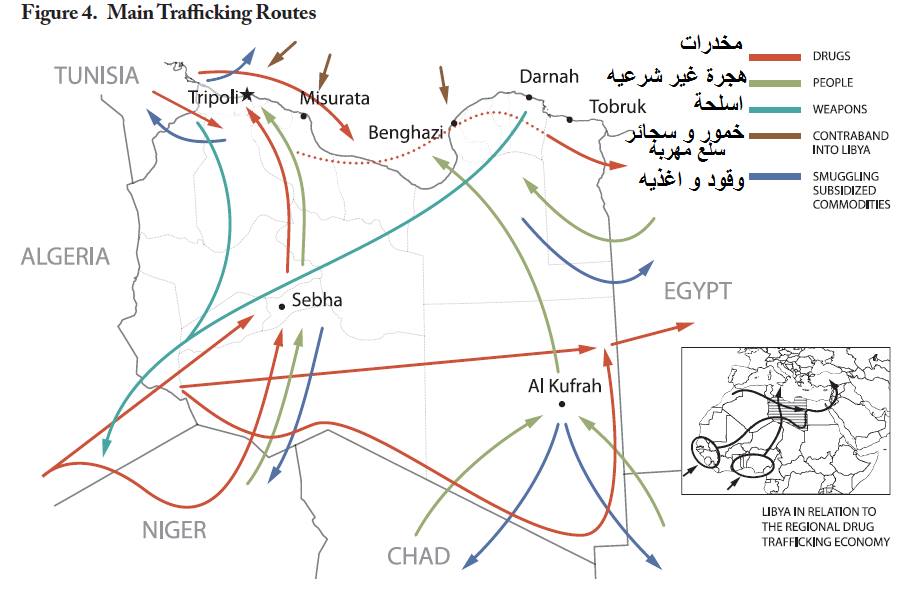
The USIP report on the illicit trade in Libya concludes that it has negative effects on Libya's stability (Photo: USIP).

The USIP report on the illicit trade in Libya concludes that it has negative . . .[restrict]effects on Libya's stability (Photo: USIP).
The USIP report on the illicit trade in Libya concludes that it has negative effects on Libya’s stability (Photo: USIP).

Tripoli, 26  February 2014:

A report on illicit trade in Libya published last Monday by the United States Institute of Peace concludes that illicit trade is driving crime and security and political instability, with regional ramifications, in transitional Libya.

This report, authored by Mark Shaw and Fiona Mangan, which draws from more than two hundred interviews across Libya, says it seeks to improve the understanding of the nature of illicit trafficking and smuggling in the country and to identify emerging patterns of organized crime and their impact on state consolidation and stability.

It goes on to say that its goal is to help define possible policy options, including ways the international community might support stability and development for the country and the region.

The study, which was supported by the International Narcotics and Law Enforcement Bureau of the U.S. State Department, is part of a portfolio of rule of law work that the United States Institute of Peace (USIP) is carrying out in Libya.

RELATED POSTS

Aldabaiba defends subsidies, grants, overspending, over-employment – will support housing but not corruption

Three million illegal immigrants in Libya, 75 % of whom are families, constitute ”settlement” which Libyans reject – illegally transfer US$ 7 billion annually: Interior Minister Trabelsi

The report says that criminal activities are driving conflict in post revolutionary Libya and undermining state consolidation. The foundation of the illicit economy in Libya rests on four interconnected markets: weapons, migrants, drugs, and smuggled goods.

A widespread prevalence of weapons has completely changed the game in Libya and has led to an industry in criminal protection. The dynamics of criminal activity and the development of illicit markets have different trajectories in northern coastal cities and inland towns and border areas, USIP says.

Many local conflicts, it reports, are driven by competition over illicit resources, and the capacity to provide or guarantee protection for illicit trade has become a major lever of influence. Criminal control is consolidating into fewer hands, and groups with the most resources are best placed to leverage control and political influence, the report has discovered.

The report says that ironically, it is the criminal economy rather than joint and inclusive governance that binds the regions of Libya together. Organized criminal behavior, illicit trafficking and trade, and the armed groups that per­petrate them are harming the transition at a time when consolidating institutions of statehood is critical, it adds.

Offering possible solutions to these problems, the USIP report says that it is imperative to begin an effective response to organized crime now—with interventions in the political, economic, social, and security spheres.

It also adds that the international community must be sensitive to Libya’s regional and international vulnerabilities.

An appropriate response may rely less on justice and security interventions and more on carefully calibrated political management coupled with well-deployed development.

Equally, the report stresses that such a response also must undercut the market for protection and reestablish state control.

Such an approach, it explains, would include marginalized groups and border communities in the political process, educate the public about the costs and consequences of illegal activities, reinstate state institutions of security to replace criminal protection arrangements, and transition from cash payouts and commodity subsidies to sustainable economic opportunities.

Ultimately, the report says that as Libya emerges from forty years of autocratic rule, the criminal economy is undermining government efforts at state consolidation. The report maps the flow of weapons, migrants, drugs, and smuggled goods through Libya and details the interactions between armed groups who control illicit markets and local communities. The authors warn that efforts to beef up border control policing will not be sufficient.

Combating organized crime in Libya, it explains, requires a broader approach that will engage marginalized groups in a political process. Failure to do so will affect not only Libya but the region as well.

For the full see: www.usip.org

[/restrict]
Tags: armed groupsCrimedrugsfeaturedillicit trademigrantsmilitiassubsidiesthuwarweapons

Related Posts

GNU to take oath at Benghazi HoR session and budget to be approved at Tripoli session: GNU
Libya

Former Culture Minister declared yesterday that she does not accept her sacking by PM Aldabaiba – today she is prevented from entering the ministry

March 4, 2026
Largest-ever Libyan government delegation to visit Washington first week of September
Libya

Libya needs unified institutions to restore economic vitality through UNSMIL’s efforts: Trumps Advisor Boulos

March 4, 2026
HoR condemns Serraj’s foreign intervention call
Libya

HoR members call for amendment of the HoR’s internal regulations – to check Ageela Saleh’s unilateral decision-making powers

March 3, 2026
Presidency Council objects to holding of south reconciliation event in Italy
Libya

As Tripoli PM Aldabaiba fills two vacant ministerial posts, Presidency Council expresses a split over the legality of their appointment

March 3, 2026
GNU to take oath at Benghazi HoR session and budget to be approved at Tripoli session: GNU
Business

PM Aldabaiba discusses with Shell activating January’s MoU expediting its return to the Libyan market – supporting its exploration and development programmes

March 2, 2026
NOC announces force majeure at Zawia port
Libya

The National Oil Corporation continues its million-tree planting campaign

March 1, 2026
Next Post
Protests at Benghazi Hospital over deteriorating security

Protests at Benghazi Hospital over deteriorating security

Ras Jedir border crossing reopens after overnight closure

Top Stories

  • Gunfire at Tripoli demonstrations calling for downfall of all corrupt domestic political entities and the UN – calling for lower prices, a cheaper dollar and better standard of living

    Gunfire at Tripoli demonstrations calling for downfall of all corrupt domestic political entities and the UN – calling for lower prices, a cheaper dollar and better standard of living

    0 shares
    Share 0 Tweet 0
  • Demonstrations continue in Zawia for the second day in a row against all incumbent political entities as standards of living continue to diminish

    0 shares
    Share 0 Tweet 0
  • PM Aldabaiba discusses with Shell activating January’s MoU expediting its return to the Libyan market – supporting its exploration and development programmes

    0 shares
    Share 0 Tweet 0
  • Hafter’s forces claim liberation of all its kidnapped soldiers at the southern Al-Toum border checkpoint from local militias

    0 shares
    Share 0 Tweet 0
  • Is Libya’s judicial system on the verge of splitting?

    0 shares
    Share 0 Tweet 0
ADVERTISEMENT
LibyaHerald

The Libya Herald first appeared on 17 February 2012 – the first anniversary of the Libyan Revolution. Since then, it has become a favourite go-to source on news about Libya, for many in Libya and around the world, regularly attracting millions of hits.

Recent News

Former Culture Minister declared yesterday that she does not accept her sacking by PM Aldabaiba – today she is prevented from entering the ministry

LIA Chairman Hassan meets Russian Ambassador Aganin – discusses reinvesting Libyan assets previously frozen by the UN Security Council

Sitemap

  • Why subscribe?
  • Terms & Conditions
  • FAQs
  • Copyright & Intellectual Property Rights
  • Subscribe now

Newsletters

    Be the first to know latest important news & events directly to your inbox.

    Sending ...

    By signing up, I agree to our TOS and Privacy Policy.

    © 2022 LibyaHerald - Powered by Sparx Solutions.

    Welcome Back!

    Login to your account below

    Forgotten Password? Sign Up

    Create New Account!

    Fill the forms below to register

    *By registering into our website, you agree to the Terms & Conditions and Privacy Policy.
    All fields are required. Log In

    Retrieve your password

    Please enter your username or email address to reset your password.

    Log In
    No Result
    View All Result
    • Login
    • Sign Up
    • Libya
    • Business
    • Advertising
    • About us
    • BusinessEye Magazine
    • Letters
    • Features
    • Why subscribe?
    • FAQs
    • Contact

    © 2022 LibyaHerald - Powered by Sparx Solutions.

    This website uses cookies. By continuing to use this website you are giving consent to cookies being used. Visit our Privacy and Cookie Policy.